If you’ve ever handled customer support, you already know the struggle. Messages keep coming in, customers expect quick replies, and your team is constantly playing catch-up.
So when people ask, “AI or traditional helpdesk – which is better?”
What they really mean is:
“Which one will actually make my life easier without breaking my workflow?”
The answer isn’t as simple as one “winning.” But once you understand how both work, the choice becomes much clearer.
First, What’s the Difference?
Traditional Helpdesk (The Old System)
A traditional helpdesk works like a queue:
- Customer sends a message
- It becomes a ticket
- A human agent picks it up
- They respond and close it
It’s structured and reliable. But it’s also manual and reactive.
AI Helpdesk (The New Approach)
AI flips this model:
- Customer sends a message
- AI reads and understands it
- AI responds instantly (or routes it smartly)
In many cases, AI can resolve the issue without human involvement
Related: Why Startups Are Switching to Servia for AI Customer Support?
Side-by-Side Comparison (What Actually Matters)
Let’s break it down in a way that reflects real-world use – not just features.
Speed
Traditional: Minutes to hours
AI: Seconds
AI responds instantly, while traditional systems depend on agent availability
If fast response is critical → AI wins
Cost
Traditional: Pay per agent
AI: Often fixed or usage-based
Traditional systems scale by hiring more people. AI scales without adding headcount.
If you want to reduce costs → AI wins
Scalability
Traditional: More tickets = more staff
AI: Handles thousands of conversations at once
AI doesn’t get overwhelmed during peak hours.
If you’re growing fast → AI wins
Availability
Traditional: Business hours (unless you hire shifts)
AI: 24/7
AI doesn’t sleep, take breaks, or miss messages.
If you want round-the-clock support → AI wins
Handling Complex Issues
Traditional: Strong (human judgment, empathy)
AI: Limited
AI struggles with emotional, unclear, or unusual problems.
If your support is complex → Traditional wins
Personalization
Traditional: Highly adaptable
AI: Improving, but still limited
Humans can read tone, emotion, and context better.
If customer relationships matter deeply → Traditional wins
Setup & Ease of Use
Traditional: Takes time (workflows, training, setup)
AI: Faster setup (sometimes hours)
AI tools can be deployed quickly by training on your content
If you need quick results → AI wins
So… Which One Actually Wins?
Here’s the honest answer:
AI Wins When:
- You have high volume, repetitive questions
- You want faster response times
- You have a small team
- You need 24/7 availability
AI can handle 60-80% of routine queries automatically in many cases
Traditional Helpdesk Wins When:
- Your issues are complex or sensitive
- You need strict tracking, compliance, or SLAs
- You rely heavily on human interaction
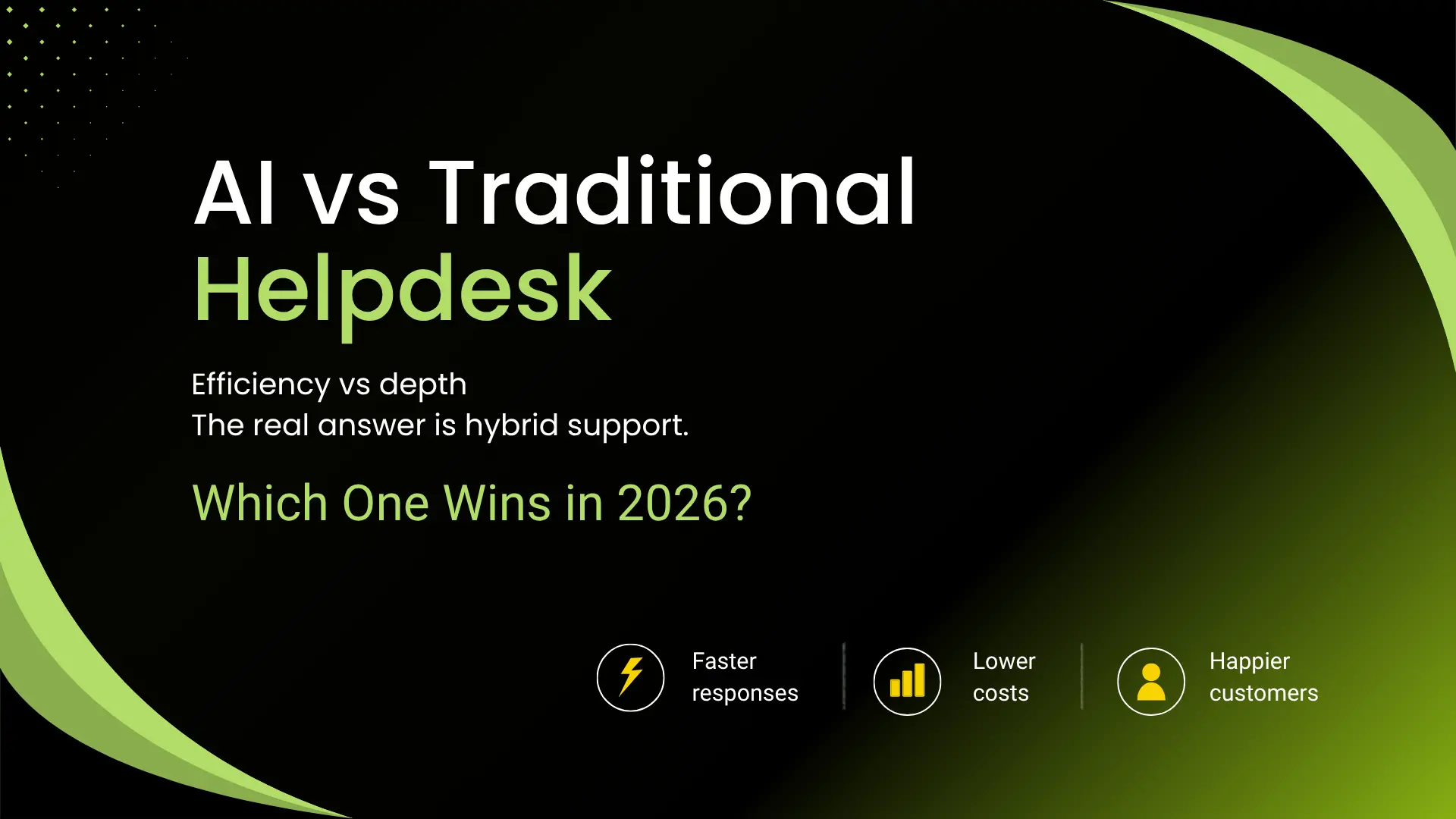
The Reality: It’s Not AI vs Traditional
The real winner in 2026 is neither.
It’s a hybrid approach.
Most modern businesses use:
- AI for first response and automation
- Humans for complex cases
This combination:
- Reduces workload
- Keeps quality high
- Improves customer experience
Even industry comparisons show the best results come from AI + human collaboration, not replacement
Related: AI Chatbots for Customer Support: What SaaS Teams Use in 2026
Real-Life Example
Let’s say you run a SaaS product
Without AI:
- 100 daily tickets
- Slow replies
- Overworked team
With AI:
AI handles password resets, FAQs, and onboarding questions
Humans handle billing issues, complaints, and edge cases
Result:
- Faster replies
- Less stress
- Better customer satisfaction
A Practical Way to Decide
Instead of asking “which is better,” ask:
How repetitive are your queries?
- High → AI
- Low → Traditional
How big is your team?
- Small → AI
- Large → Traditional or hybrid
How important is speed vs personalization?
- Speed → AI
- Personalization → Traditional
Common Mistakes to Avoid
Many businesses try to:
Replace everything with AI at once
That usually fails.
A better approach:
- Start with FAQs
- Automate simple queries
- Gradually expand
Final Takeaway
AI doesn’t “replace” traditional helpdesks – it changes how they work.
- AI handles the repetitive, fast, and scalable tasks
- Humans handle the complex, emotional, high-value ones
So who wins?
If your goal is to grow without overwhelming your team, the smartest move isn’t choosing one – it’s using both the right way.