
Startups don’t struggle with a lack of tools. They struggle with too many things to manage at once.
Customer messages pile up. Emails get missed. Response times slow down. And hiring a full support team isn’t always possible early on.
Most helpdesk tools try to fix this by adding more features.
Servia takes a different approach – it focuses on reducing the chaos first.
That’s what makes it stand out, especially for startups.
What Makes Servia Different From Traditional Helpdesks
Most tools start with tickets.
Servia starts with conversations and outcomes.
Instead of just helping you manage support, it actively helps you resolve it faster.
Here’s how:
AI That Actually Resolves Queries (Not Just Assists)
Many platforms suggest replies. You still have to send them.
Servia goes further:
- Automatically answers common questions
- Resolves issues in real-time
- Handles FAQs without human input
In fact, its AI can automate a large portion of repetitive queries and respond in under a second
Related: Top 6 AI Helpdesk Software Compared: Features, Pricing & Use Cases (2026)
Why this matters for startups:
You don’t need to hire support agents early – you can let AI handle the bulk.
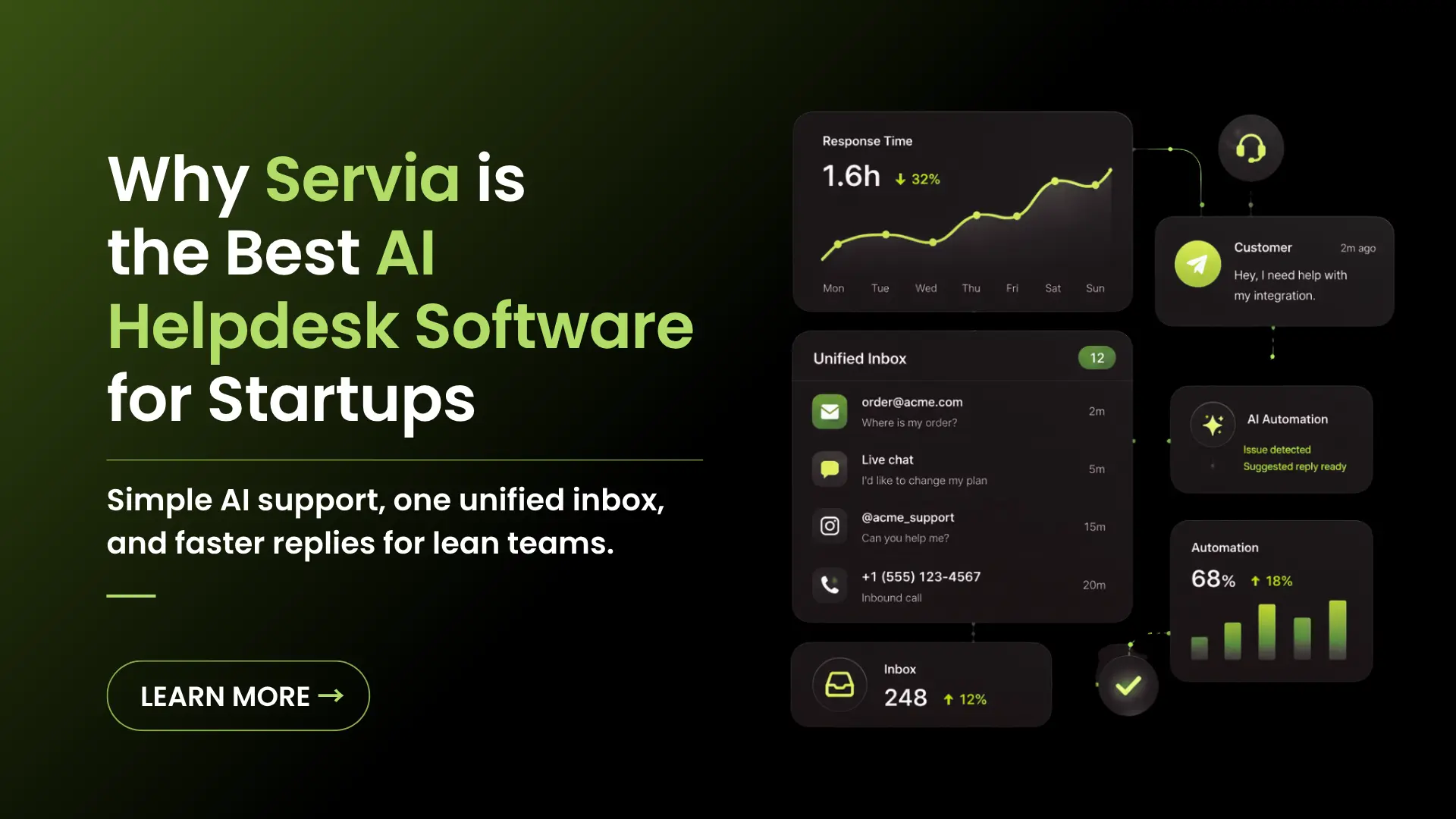
One Inbox for Everything
Startups often manage:
- Emails
- Website chat
- Social media messages
This creates scattered conversations.
Servia combines all of these into a single intelligent inbox, so nothing gets lost.
Example:
A customer emails you, then follows up on Instagram.
Instead of two separate threads, you see one full conversation.
Real-Time Context (So You Don’t Guess)
Most tools show messages.
Servia shows what’s happening behind the message.
It’s AI:
- Reads customer intent
- Pulls past interactions
- Suggests the best next action
So instead of thinking “what should I reply?”, you already know.
Prioritization Without Manual Work
Startups don’t just need to reply fast – they need to reply to the right things first.
Servia automatically:
- Highlights urgent issues
- Routes complex tickets to the right person
- Handles simple ones instantly
This removes the need for manual sorting or constant monitoring.
Related: Best AI Customer Support Software for Small Businesses (2026)
Built for Speed (Not Setup Headaches)
One of the biggest problems with traditional helpdesks is setup time.
Servia focuses on:
- Quick onboarding (minutes, not weeks)
- Minimal configuration
- Immediate results
According to its platform, teams can start seeing faster response times almost instantly after setup.
For startups, speed matters more than advanced customization.
e-commerce store.
How Servia Helps Startups Grow (Not Just Survive)
Most tools help you manage support.
Servia helps you scale it without growing your team immediately.
Reduces hiring pressure
AI handles repetitive work, so you don’t need a large support team early.
Improves customer experience
Instant replies feel professional—even for a small startup.
Gives visibility into performance
You can track:
- Response time
- Customer satisfaction
- Common issues
This helps you improve faster.
Where Servia Might Not Be Perfect
Final Takeaway
Servia stands out not because it has more features, but because it focuses on what startups actually need.
It removes the busywork, speeds up responses, and keeps everything in one place.
If your biggest challenge is handling customer support with limited resources, Servia isn’t just another tool – it’s a way to stay efficient while you grow.
Is Servia better than Zendesk for startups?
For early-stage startups, yes. It’s simpler, faster to set up, and more focused on automation rather than complex workflows.
Can Servia fully replace human support agents?
Not completely. It handles repetitive queries, but humans are still needed for complex or sensitive issues.
How quickly can a startup start using Servia?
Setup can take just minutes, and you can start seeing results almost immediately.
Does Servia support multiple communication channels?
Yes. It combines email, chat, and social platforms into one inbox.
Is Servia suitable for scaling businesses?
Yes. It’s built to handle increasing ticket volume without requiring a proportional increase in team size.