AI platforms have become the most useful application for artificial intelligence in customer service. For SaaS enterprises managing round-clock availabilty, chatbots promise faster responses, growing user bases, and reduced ticket volume.
While so many of the teams adopt AI chatbots, expecting faster results, the real help comes from ‘how’ these tools work and are implemented.
This blog helps us understand how modern AI bots are used in SaaS customer service, where they fall short, where they work best, and how Servia helps businesses strike the right balance between human support and automation.
Why AI Chatbots Are Gaining Traction in SaaS Support
SaaS customers expect immediate help. Whether it’s a login issue, billing question, or feature clarification, waiting hours for a response is no longer acceptable.
AI chatbots address this by offering:
- Scalable support without linear cost growth
- Instant responses across time zones
- Consistent answers based on knowledge bases
- Reduced pressure on human agents
Platforms such as Kustomer, Gorgias, and Zendesk have integrated chatbots into their ecosystems to meet these expectations. However, modern SaaS teams are learning that chatbots are most effective when paired with broader support workflows, not deployed in isolation.
From Scripted Bots to Intelligent AI Chatbots
Early chatbots relied on rigid scripts and predefined flows. While they handled basic FAQs, they often frustrated users when conversations deviated from expected paths.
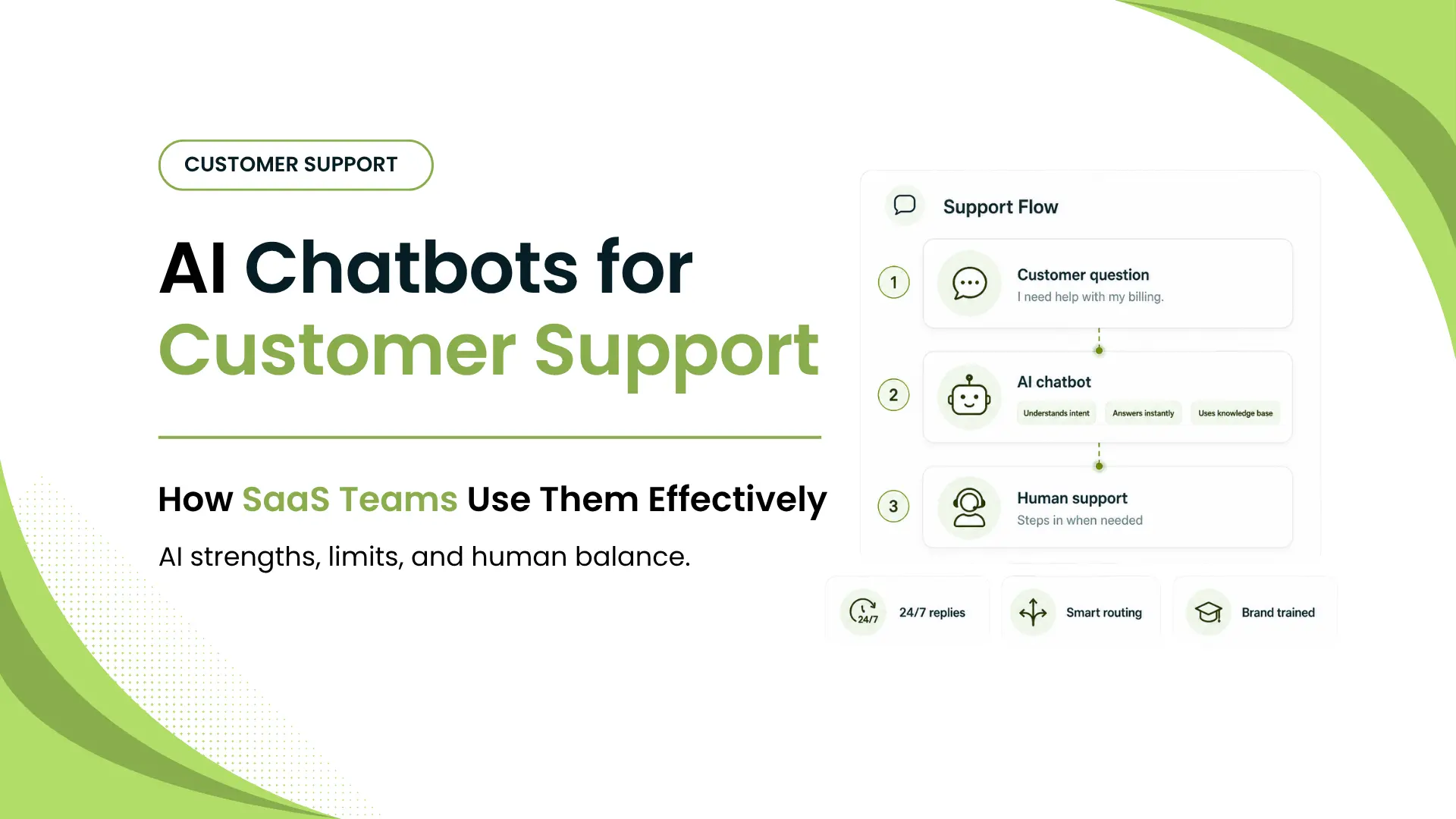
Modern AI chatbots are fundamentally different. They use natural language understanding (NLU) to interpret intent, sentiment, and context, allowing conversations to adapt in real time.
What modern AI chatbots can do:
- Understand the varied phrasing of the same question
- Pull answers from live knowledge sources
- Maintain context across multiple messages
- Escalate seamlessly to human agents
This shift mirrors how platforms like Kustomer emphasize customer context and continuity rather than isolated interactions.
Where AI Chatbots Work Best in Customer Support
AI chatbots are not a universal solution, but they excel in specific scenarios common to SaaS businesses.
High-impact chatbot use cases
Self-service guidance
Directing users to relevant documentation or walkthroughs.
Frequently asked questions
Product usage, pricing, onboarding steps, and account setup queries.
Account and billing requests
Invoices, subscription status, and payment updates.
Status and availability checks
Outages, maintenance windows, feature rollouts.
Related: Best Support Software for E-commerce Brands in 2026
Where Chatbots Fall Short Without Human Support
Despite their strengths, AI chatbots have limitations, especially in SaaS environments where complexity is high.
Chatbots struggle most with:
- Multi-step technical issues
- Edge cases and bugs
- Emotionally frustrated customers
- Enterprise or high-value accounts
This is why leading SaaS support platforms don’t aim for full automation. Instead, they prioritize smooth handoffs from chatbot to human agent.
AI Chatbots vs Human Agents: A Collaborative Model
The most effective SaaS support teams don’t treat AI chatbots as replacements for agents. They treat them as frontline assistants.
In a collaborative model:
- AI supports agents with suggestions and insights
- Chatbots handle speed and scale
- Humans handle judgment and empathy
This philosophy aligns with how platforms like Zendesk position AI as an augmentation layer rather than a standalone solution.
Measuring the Impact of AI Chatbots
To understand whether AI chatbots are delivering value, SaaS teams should track:
- Chatbot resolution rate
- Deflection of repetitive tickets
- First response time
- Escalation frequency
- Customer satisfaction (CSAT)
AI analytics help teams refine chatbot behavior, improve knowledge coverage, and identify gaps.
How Leading Platforms Approach AI Chatbots
Different vendors emphasize different strengths:
- Servia centers on clarity, control, and agent empowerment
- Zendesk focuses on enterprise-grade automation and scale
- Kustomer emphasizes conversational continuity and CRM depth
- Gorgias prioritizes fast, chat-first experiences
For SaaS teams, the right choice depends on product complexity, customer expectations, and support maturity.
Choosing the Right AI Chatbot for Your SaaS Team
Before adopting an AI chatbot, SaaS leaders should ask:
- Can agents easily take over conversations?
- Which conversations are repetitive today?
- Where do customers experience the most friction?
- How often do issues require human judgment?
The best chatbot is one that improves the experience without blocking resolution.
Final Thoughts: AI Chatbots Should Reduce Friction, Not Trust
AI chatbots are now a standard part of SaaS customer support, but their success depends on thoughtful implementation.
When chatbots are designed to assist rather than replace humans, they reduce wait times, improve consistency, and free agents to focus on complex issues. When poorly implemented, they frustrate users and increase churn.
SaaS teams that invest in balanced, AI-powered support platforms – like Servia – gain the ability to scale support while maintaining trust, context, and control.
As customer expectations continue to rise, AI chatbots will play a growing role, but always as part of a broader, human-centered support strategy.
Are AI chatbots effective for SaaS customer support?
Yes, AI chatbots are highly effective for handling repetitive, high-volume inquiries such as FAQs, billing questions, and onboarding guidance. For complex issues, they work best when paired with seamless human escalation.
Can AI chatbots fully replace human support agents?
No. AI chatbots are designed to support agents, not replace them. Human agents remain essential for complex, emotional, or high-impact customer interactions.
How do AI chatbots improve response times?
AI chatbots provide instant responses 24/7, reducing wait times and improving first-response metrics, especially during peak hours or across time zones.
What should SaaS companies look for in an AI chatbot?
Key factors include intent understanding, knowledge base integration, easy human handoff, analytics visibility, and ease of setup without heavy technical effort.
How does Servia’s AI chatbot differ from traditional bots?
Servia’s AI chatbot is context-aware, integrated across channels, and designed to support human agents. It focuses on clarity, control, and seamless escalation, rather than rigid scripts or isolated automation.