A smart autonomous helpdesk has become one of the most important parts of growth for SaaS companies. As user expectations rise and products scale, support teams find it difficult to deliver faster responses, consistent service, and personalized experiences all without increasing the cost.
This problem has generated an ongoing debate: AI vs human customer support
Ideally, SaaS strategies do not choose one over the other; they combine the two and use them together. They combine human expertise and AI to improve the quality of their services while preserving the human element that the customers expect.
This blog breaks down the features of humans and AI in modern customer support, how SaaS companies can strike the right balance, and where each excels using modern helpdesk platforms like Servia.
The Evolution of Customer Support in SaaS
Traditional SaaS support teams used to rely heavily on manual ticketing systems. Still, as the user bases grew, the teams found it difficult to keep up with high volumes, limited visibility, and slow response times.
To address and solve this, helpdesks such as Kustomer, Gorgias, and Zendesk introduced omnichannel inboxes, reporting, and automation. Recently, AI has taken the charge, reshaping how support teams operate and integrate.
Modern SaaS helpdesk software now blends:
- Human-led problem solving
- Automation and routing
- AI-driven insights
This evolution marks a bigger shift: support no longer means just resolving tickets; it is about delivering high-quality, scalable customer experiences.
5 Best Helpdesk Software Tools for SaaS Companies in 2026 →
Compare top SaaS helpdesk platforms and choose the right one for your team.
What AI Brings to Customer Support
In today’s SaaS helpdesks, AI has moved far above scripted chatbots. AI plays an important role in improving consistency, supporting agents in real time, and handling volume.
Key Strengths of AI-Powered Customer Support
Speed at Scale
Respond instantly across email, chat, and in-app messaging—24/7 without delays.
Consistency
Deliver accurate, policy-aligned responses with zero variation between agents.
Automation
Handle repetitive queries like billing, status checks, and password resets.
Insights
Identify trends, gaps, and recurring issues from large volumes of tickets.
Platforms like Servia’s AI-powered helpdesk are designed to automate upto
60–80%
of routine inquiries—helping SaaS teams scale support without increasing headcount.
Where Human Support Still Matters Most
Despite AI’s advantages, human agents remain essential – especially in SaaS environments where complexity and trust matter.
Strengths of human-led support
Contextual decision-making
Humans can weighcustomer history, business priorities, and nuance in ways AI alone cannot.
This is why software like Kustomer shifts its focus to agent empowerment and customer context rather than complete automation.
Emotional intelligence and empathy
Customers dealing with confusion, high-stakes issues, and frustration do not need automation; it requires reassurance
Complex problem solving
Edge cases, multi-step workflows, and product bugs require judgment, collaboration, and reasoning.
Relationship building
For enterprise or high-value customers, good human relationships carry expansion and retention.
AI vs Human Support: A False Choice
For SaaS companies, framing the conversation as AI vs human misses the point.
The real question is: how can humans and AI work hand-in-hand to deliver better support?
Modern helpdesk platforms act as a collaboration layer where:
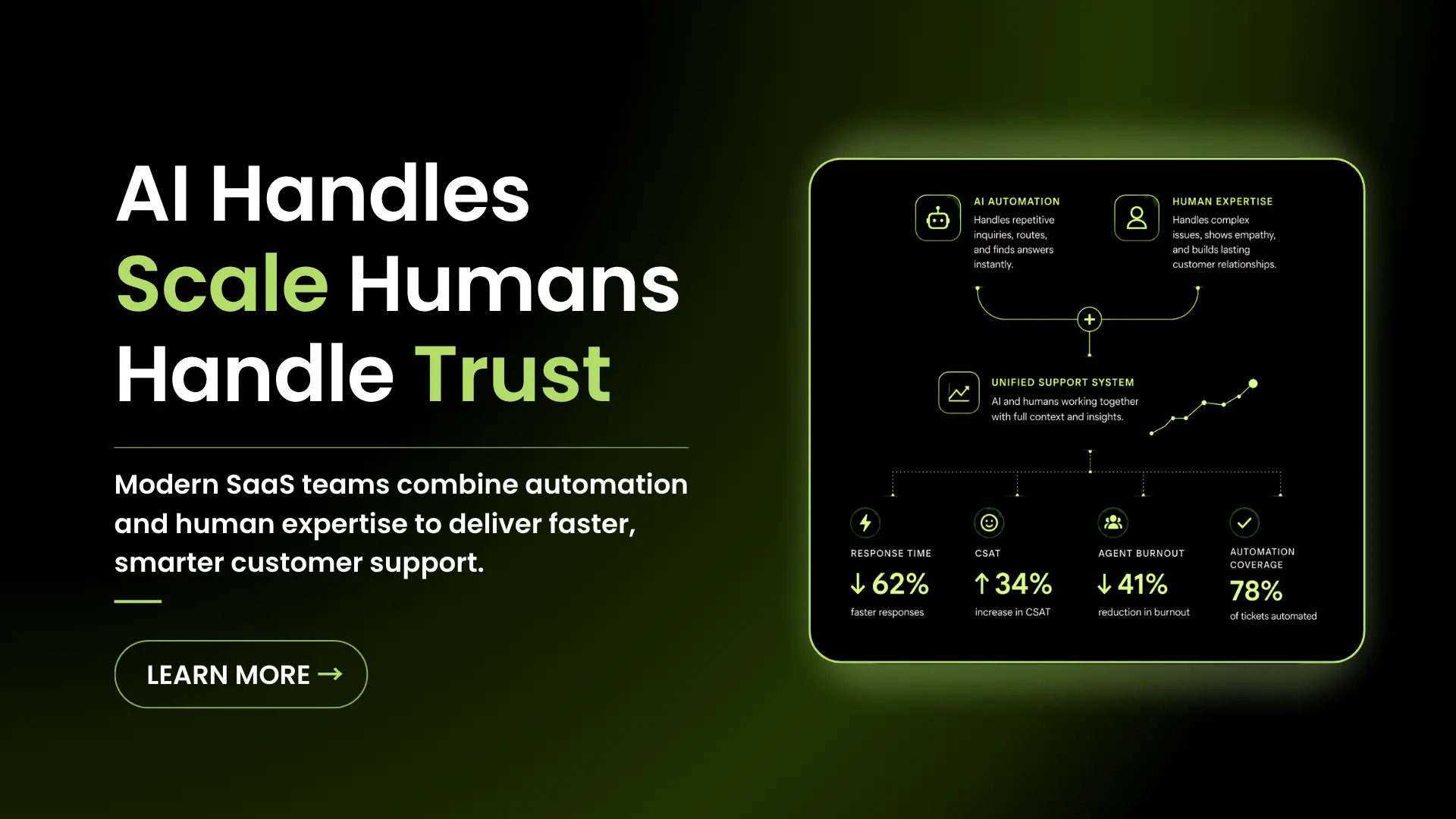
- Humans handle complexity, empathy, and judgment
- AI handles speed, scale, and consistency
Servia is made according to this philosophy.
Its AI assists agents with intelligent routing, full conversation context, and real-time suggestions, without removing human control.
How AI Supports Human Agents (Without Replacing Them)
The most successful SaaS support teams use AI as a force multiplier.
Examples of AI-human collaboration
With Servia’s unified workspace, agents stay focused on meaningful conversations while AI handles background work.
Intelligent routing
AI analyzes intent, urgency, and sentiment to route conversations to the right agent, similar to workflows used in Zendesk and Gorgias.
Suggested responses
AI recommends accurate replies based on past resolutions and knowledge articles, helping agents respond faster.
Context surfacing
Conversation history, account data, and internal notes are surfaced automatically, reducing manual lookups.
Quality and consistency checks
AI helps maintain tone, compliance, and accuracy across responses.
Customer Expectations Are Driving the Shift
SaaS customers expect:
- Minimal back-and-forth
- Instant responses
- Consistent answers across channels
- Personalized support
Meeting these expectations manually is nearly impossible at scale.
This is why AI-powered helpdesks, like those offered by Zendesk, Kustomer, and modern platforms such as Servia, are becoming the standard rather than the exception.
AI ensures speed and availability, while human agents ensure trust and resolution quality.
Measuring Success: AI + Human Support
The effectiveness of AI-human collaboration can be seen in key SaaS support metrics:
- Agent workload and burnout
- First response time
- Resolution time
- Customer satisfaction (CSAT)
- Ticket deflection rate
Modern platforms provide visibility into these metrics through advanced analytics.
These insights help SaaS leaders continuously optimize automation while ensuring agents remain empowered, not overwhelmed.
Common Concerns About AI in Customer Support
Choosing the Right Balance for Your SaaS Company
When evaluating AI-powered helpdesk software, SaaS teams should consider:
🔁 How much of your support volume is repetitive
🧩 The complexity of your product and workflows
🎯 The level of personalization your customers expect
📈 Your team’s workload and future growth plans
The goal isn’t maximum automation,
it’s maximum impact.
Platforms like Servia are designed to grow with your support maturity—allowing you to gradually increase automation while maintaining full control over the customer experience.
Final Thoughts: The Future of SaaS Support Is Collaborative
The debate between AI vs human customer support is no longer about replacement; it’s about collaboration.
AI delivers speed, scale, and consistency. Humans deliver empathy, insight, and trust. Together, they create support experiences that are efficient, personal, and sustainable.
For SaaS companies competing on experience as much as product, investing in a modern helpdesk platform that balances AI and human support, like Servia, is no longer optional. It’s a strategic advantage.
As AI continues to evolve, the SaaS teams that win will be those who use it not to remove humans from the equation, but to help them do their best work.
Frequently Asked Questions
How does AI improve agent productivity in SaaS support teams?
AI improves agent productivity by handling routine tasks, suggesting accurate responses, surfacing full customer context, and intelligently routing conversations. This reduces manual work, shortens resolution times, and helps agents manage more conversations without increasing workload or burnout.
How should SaaS companies choose an AI-powered helpdesk?
SaaS companies should look for a helpdesk that balances automation with human control. Key factors include ease of adoption, depth of AI automation, omnichannel support, analytics visibility, and seamless human handoff. Platforms like Servia focus on augmenting agents with AI while keeping teams in control of the customer experience.
Is AI customer support better than human support for SaaS companies?
AI customer support is not inherently better than human support; it serves a different purpose. AI excels at handling high volumes of repetitive requests quickly and consistently, while human agents are essential for complex issues, emotional situations, and relationship-driven support. The most effective SaaS teams use a hybrid approach where AI and humans work together.
Can AI fully replace human support agents?
No. While AI can automate routine inquiries and assist with decision-making, it cannot replace human judgment, empathy, or nuanced problem-solving. Modern SaaS helpdesk platforms, including Servia, are designed to support agents rather than replace them.
What types of support requests are best handled by AI?
AI is best suited for repetitive, predictable requests such as password resets, billing questions, order status updates, and knowledge base lookups. These inquiries can often be resolved instantly through automation, reducing ticket volume and allowing human agents to focus on higher-value conversations.