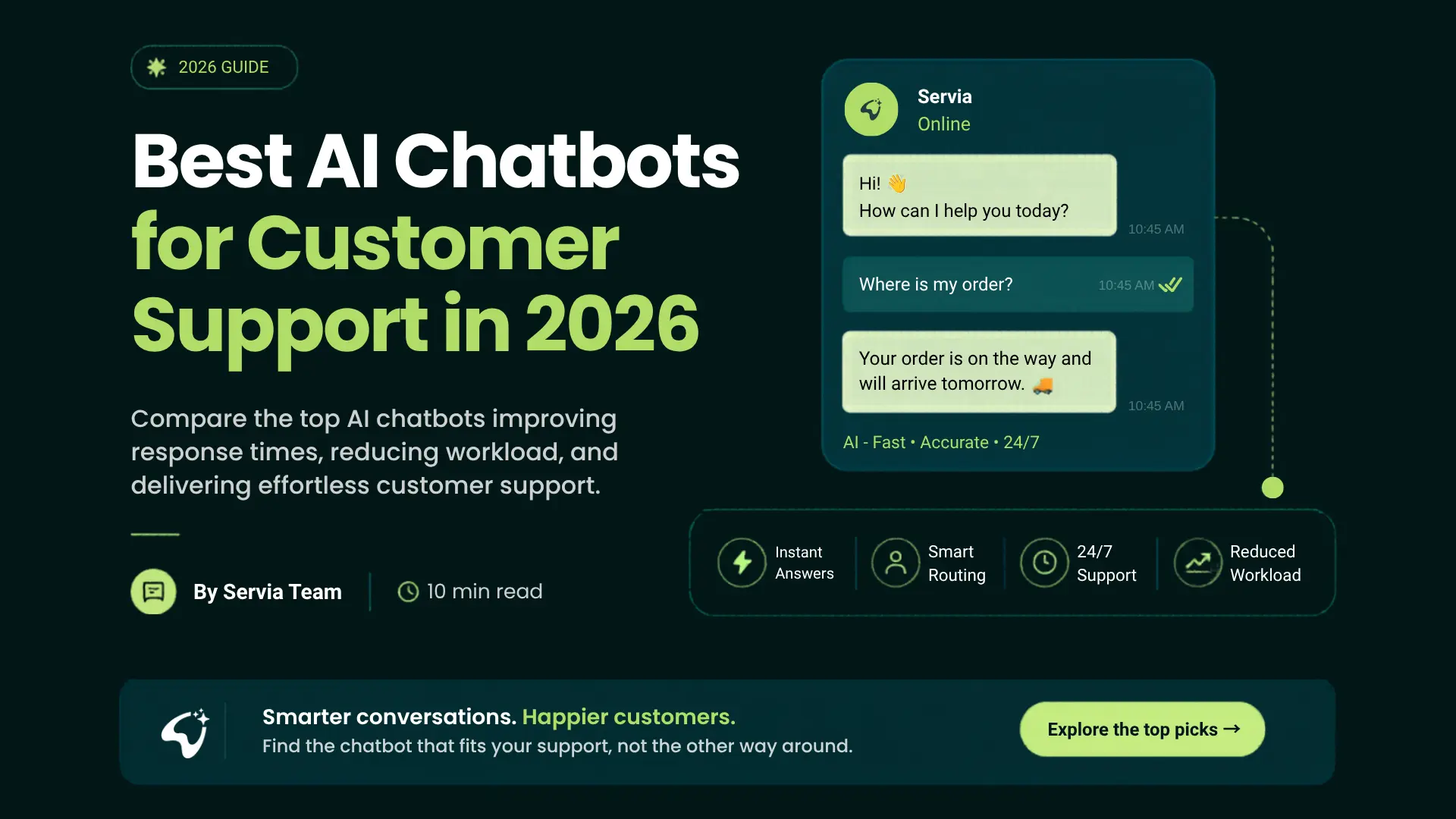
Customer support has changed dramatically over the last few years.
People no longer want to wait hours for replies or sit in long support queues just to reset a password or track an order. Customers expect fast, accurate answers instantly – regardless of the time or platform.
That’s exactly why AI chatbots have become one of the most important tools for modern businesses.
But here’s the problem:
There are now hundreds of AI chatbot platforms claiming to be the “Best”
Some focus on automation. Others focus on live chat. Some work well for ecommerce, while others are designed for SaaS or enterprise support.
So instead of looking for the chatbot with the most features, businesses should focus on something simpler:
Which AI chatbot actually improves customer support without making operations more complicated?
This guide on Servia breaks down the best AI chatbots for customer support in 2026, including their strengths, weaknesses, and ideal use cases.
What Makes an AI Chatbot Good for Customer Support?
A customer support chatbot should do more than just reply automatically.
The Best AI Chatbots Help Businesses:
A weak chatbot creates frustration. A strong chatbot makes support feel effortless.
That difference matters.
Related: Best Omnichannel Customer Support Software for Ecommerce Brands (2026)
Best AI Chatbots for Customer Support in 2026
Intercom Fin
Intercom’s AI chatbot, Fin, has become one of the strongest AI customer support solutions available today.
Unlike older bots that relied heavily on scripted flows, Fin uses AI to understand context and answer customer questions conversationally.
Why do businesses like it
- Natural conversations
- Strong knowledge base integration
- Excellent onboarding support
- Fast handoff to human agents
Real-world example
A SaaS customer asks:
“Why can’t I access my dashboard?”
Fin can:
- Check account-related help docs
- Suggest troubleshooting steps
- Escalate to support if needed
-all within seconds.
Limitation
Pricing can become expensive as support volume increases.
Zendesk AI
Zendesk has integrated AI deeply into its support ecosystem.
Its chatbot system focuses heavily on:
- Ticket automation
- Smart routing
- AI-generated responses
- Self-service support
Why it works well
Zendesk is strong for companies managing:
- Large ticket volumes
- Multiple support channels
- Enterprise workflows
Best use case
Businesses that already rely heavily on ticket-based support systems.
Limitation
The setup and workflow configuration can feel overwhelming for smaller teams.
Tidio AI
Tidio has become popular because it’s simple, affordable, and quick to deploy.
Its Lyro AI chatbot can automatically answer common customer questions without requiring a complicated setup.
Why small businesses prefer it
- Beginner-friendly dashboard
- Affordable pricing
- Fast website integration
- Great for FAQs and order tracking
Example
An ecommerce customer asks:
“Where is my package?”
The AI can instantly provide shipping updates instead of waiting for an agent.
Limitation
Not ideal for highly technical or enterprise-level support workflows.
Drift
Drift combines AI chat with lead qualification and customer engagement.
While it’s often known as a sales platform, many companies use it for customer support as well.
Strongest features
- Conversational messaging
- AI lead routing
- Real-time engagement
- Personalized support interactions
Best use case
Businesses where sales and support conversations overlap heavily.
Limitation
Less focused on traditional support ticket management.
Servia
Servia approaches customer support differently.
Instead of only focusing on automated replies, it focuses on:
- Conversation prioritization
- Smart workflow management
- Faster issue handling
- Unified support visibility
Why it stands out
Servia helps teams identify:
- Which conversations matter most
- Which issues are repetitive
- Which tickets require urgent human attention
This reduces support chaos instead of simply adding automation.
Best use case
Growing startups and lean support teams are handling increasing customer volume.
Limitation
Still newer compared to long-established enterprise platforms.
What Features Actually Matter in an AI Chatbot?
A lot of companies get distracted by flashy AI claims.
But in real customer support environments, these are the features that matter most:
Natural Conversation Quality
Customers can immediately tell when a chatbot feels robotic.
The best chatbots:
- Understand intent
- Respond conversationally
- Handle follow-up questions naturally
Fast Human Handoff
AI should not trap customers inside endless automated loops.
A good chatbot knows:
- When to escalate
- When humans should step in
Omnichannel Support
Customers contact businesses through:
- Website chat
- Facebook Messenger
The chatbot should connect everything into one experience.
Knowledge Base Integration
Strong AI chatbots learn from:
- FAQs
- Help center articles
- Internal documentation
This improves response accuracy significantly.
Related: AI vs Traditional Helpdesk Software: Which Is Better in 2026?
AI Chatbots vs Human Support
One common fear businesses have is:
Will AI Replace Human Support Agents?
Not Really
The best customer support systems use a hybrid model:
AI handles repetitive questions
Humans handle complex or emotional issues
This creates:
AI works best as an assistant – not a complete replacement.
Common Mistakes Businesses Make
1. Automating too much too early
Businesses often try to replace entire support teams immediately.
That usually creates frustration.
A better approach:
- Start with FAQs
- Automate repetitive tasks first
- Expand gradually
2. Choosing based only on price
Cheap chatbots often:
- Sound robotic
- Lack integrations
- Create poor customer experiences
The goal is to reduce workload without hurting support quality.
3. Ignoring setup quality
Even the best AI chatbot performs badly if:
- Knowledge bases are outdated
- FAQs are unclear
- Support flows are poorly organized
AI depends heavily on the quality of the information it receives.
How to Choose the Right AI Chatbot
Final Takeaway
The best AI chatbot for customer support in 2026 isn’t necessarily the one with the most advanced AI.
It’s the one that:
- Reduces repetitive work
- Improves response time
- Keeps support organized
- Makes customer interactions smoother
For some businesses, that means enterprise automation.
For others, it means simplicity and speed.
The important thing is choosing a chatbot that supports your team – not one that creates more work to manage.
Frequently Asked Questions
What is the best AI chatbot for customer support in 2026?
It depends on your business type. Intercom Fin is strong for SaaS, Tidio works well for small businesses, and Zendesk AI is better for large support operations.
Can AI chatbots fully replace customer support agents?
No. AI is best for simple, repetitive questions, while human agents are still necessary for complex or emotional customer issues.
Are AI chatbots expensive for small businesses?
Not always. Tools like Tidio offer affordable plans for smaller businesses, while enterprise tools like Zendesk may cost more as support volume grows.
How do AI chatbots improve customer support?
They provide instant replies, automate repetitive tasks, reduce support workload, and help businesses offer 24/7 customer service.
Which industries benefit most from AI customer support chatbots?
Ecommerce, SaaS, fintech, healthcare, and online service businesses benefit heavily because they handle large volumes of customer inquiries daily.