
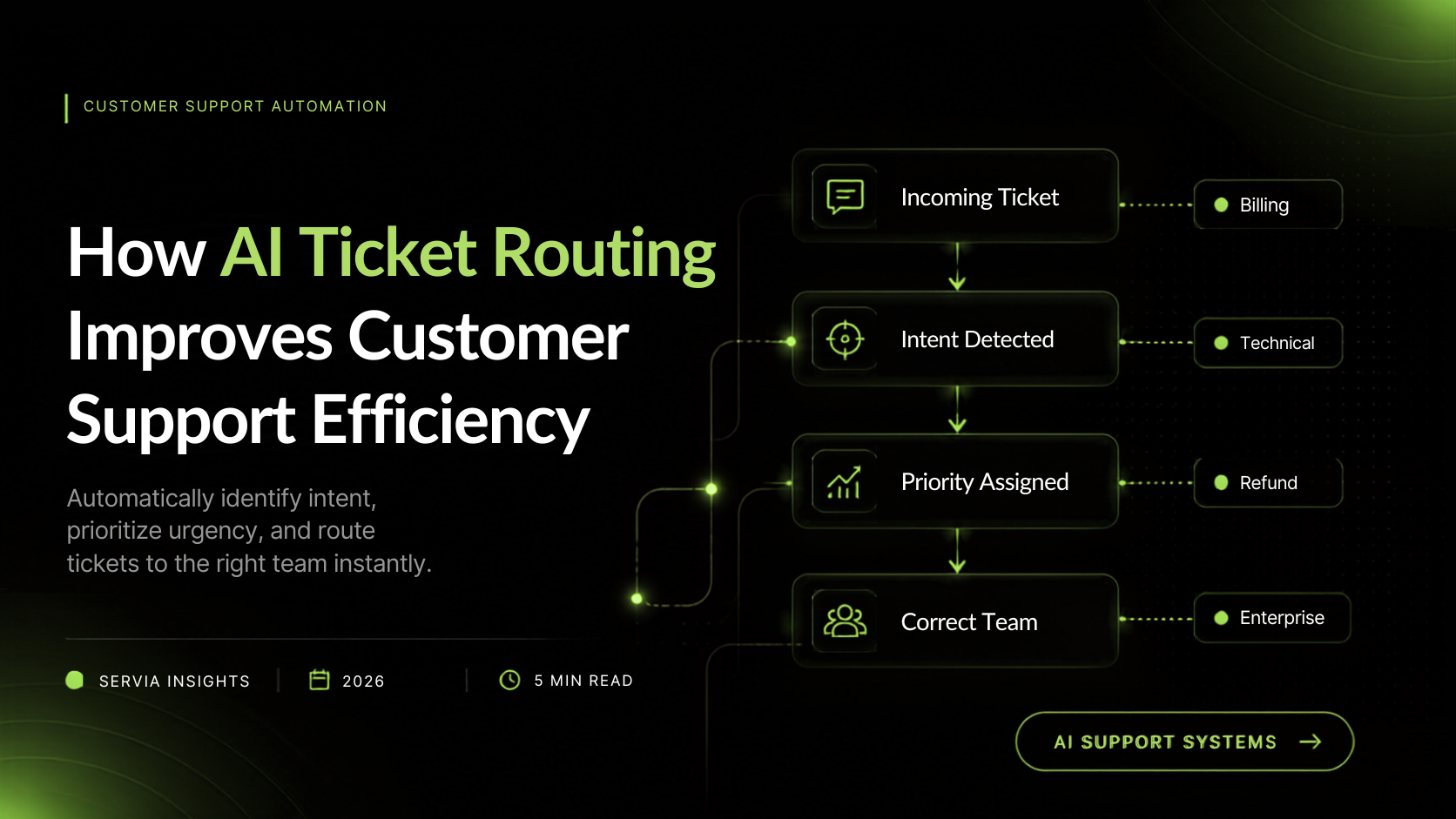
This is where AI ticket routing changes everything.
Instead of relying on manual sorting, AI can understand incoming customer requests, determine urgency, categorize the issue, and instantly route conversations to the most suitable agent or department.
Let’s explore how AI ticket routing works and why it has become an essential part of modern customer support at Servia.
What Is AI Ticket Routing?
AI ticket routing is the process of using artificial intelligence to automatically analyze customer conversations and assign them to the appropriate support channel, department, or agent.
A traditional support workflow often looks like this:
→
Agent reads the message
→
Agent identifies the issue
→
Agent assigns the ticket
→
Customer waits for the right person
With AI ticket routing, the workflow becomes:
→
AI understands intent
→
AI identifies priority
→
AI assigns the ticket
→
Right team responds faster
Related: 5 Best Helpdesk Software Tools for SaaS Companies in 2026
How Does AI Ticket Routing Work?
Behind every smart routing system is a combination of AI technologies working together.
Intent Detection
The first step is understanding what the customer actually needs.
AI analyzes the language in a message to identify the customer’s intent.
For example:
Customer message:
I was charged twice for my subscription and need a refund.
The AI recognizes that this is a billing issue.
It automatically applies the appropriate tag and sends it to the finance or billing support team.
Sentiment Analysis and Priority Detection
Not all support requests have the same urgency.
A customer asking:
How do I change my profile picture?
does not require the same attention as:
“My entire account is locked, and I cannot access my business data.”
AI identifies signals like urgency, frustration, or business impact and moves critical tickets to the front of the queue.
This ensures serious issues are not buried beneath routine questions.
Automatic Categorization
Many support teams spend hours every week tagging tickets manually.
AI can automatically classify requests such as:
✓ Technical problems
✓ Product questions
✓ Account management
✓ Feature requests
✓ Refund inquiries
This keeps support queues organized without requiring manual sorting.
Agent Skill-Based Routing
The best support systems don’t simply send tickets to the next available person.
They send them to the person most capable of solving the problem.
For example:
Subscription problems go to the billing teams.
Enterprise customers are assigned to senior support agents.
This improves first-contact resolution and reduces unnecessary transfers.
The Biggest Benefits of AI Ticket Routing
Faster Response Times
Customers expect quick answers.
When tickets are automatically sorted and assigned immediately, support teams can start working on the issue sooner instead of spending time organizing the queue.
Reduced Agent Workload
Support agents should spend their time solving customer problems – not moving tickets between folders.
AI removes repetitive administrative tasks such as:
- Reading every incoming message
- Applying tags
- Selecting departments
- Determining priority levels
This gives agents more time for meaningful customer interactions.
Improved Customer Satisfaction
Nothing frustrates customers more than explaining their issue multiple times or being transferred between teams.
AI routing ensures customers reach the right person faster, creating smoother support experiences.
Better Scalability for Growing Businesses
Many companies reach a point where customer conversations grow faster than their support team.
The first instinct is often to hire more agents.
But many support bottlenecks are caused by inefficient workflows, not just a lack of people.
AI routing helps businesses handle larger ticket volumes without increasing operational complexity.
Related: AI vs Traditional Helpdesk Software: Which Is Better in 2026?
AI Ticket Routing vs Manual Ticket Assignment
Real-World Example:
A Growing SaaS Support Team
Imagine a SaaS company receiving 500 support requests every day.
Without AI routing:
- Agents manually review each ticket.
- Urgent technical issues may get delayed.
- Tickets are often assigned to the wrong department.
- Response times increase as the company grows.
With AI ticket routing:
- Technical issues are sent directly to specialists.
- Billing requests go to the finance team.
- Common questions are identified immediately.
- High-priority customers receive faster attention.
The support team spends less time managing tickets and more time resolving them.
Related: Top Customer Support Ticketing Systems for SaaS Companies (2026)
Common Mistakes to Avoid When Implementing AI Ticket Routing
Automating Without Clear Categories
AI performs best when your support structure is organized.
Before implementing AI routing, define clear categories, priorities, and escalation rules.
Removing Human Oversight Completely
AI is excellent at handling repetitive decisions, but complex situations may still require human judgment.
The best support teams use AI as an assistant, not a replacement.
Ignoring Customer Context
A good AI routing system should consider customer history, account importance, and previous conversations – not just the latest message.
Context leads to better decisions.
How Servia Uses AI Ticket Routing to Simplify Support
Servia takes AI ticket routing beyond basic ticket assignment.
Instead of creating another complicated workflow system, Servia focuses on helping teams understand what requires attention first.
With AI-powered conversation analysis, Servia helps businesses:
- Automatically identify customer intent
- Prioritize urgent conversations
- Organize support requests intelligently
- Reduce repetitive manual triage
- Give teams clearer visibility into their support operations
This allows lean teams to deliver faster support without adding unnecessary operational complexity.
Final Takeaway
As businesses grow, customer support does not become difficult simply because there are more tickets.
It becomes difficult because there are more decisions.
Which Department Should Handle this Issue?
Which Conversations can be Resolved Automatically?
AI ticket routing removes these repetitive decisions from your team’s workload.
By understanding customer intent, identifying urgency, and sending tickets to the right people instantly, AI helps businesses deliver faster, more organized, and more efficient customer support.
The companies that scale customer support successfully are not always the ones with the largest teams.
They are the ones with the smartest systems.
Frequently Asked Questions
What is AI ticket routing?
AI ticket routing uses artificial intelligence to analyze customer messages, determine their intent and urgency, and automatically assign them to the appropriate team or agent.
How does AI ticket routing improve customer support?
It reduces manual ticket sorting, speeds up response times, ensures customers reach the right agent faster, and helps support teams handle larger volumes of requests efficiently.
Can AI ticket routing replace customer support and agents?
No. AI handles repetitive tasks like categorization and assignment, while human agents focus on complex issues that require empathy, decision-making, and expertise.
Is AI ticket routing useful for small businesses?
Yes. Small teams can use AI routing to stay organized, manage growing customer conversations, and improve support quality without hiring large teams.
What types of tickets can AI route?
AI can route many types of requests, including technical issues, billing questions, account problems, product inquiries, refund requests, and customer complaints.