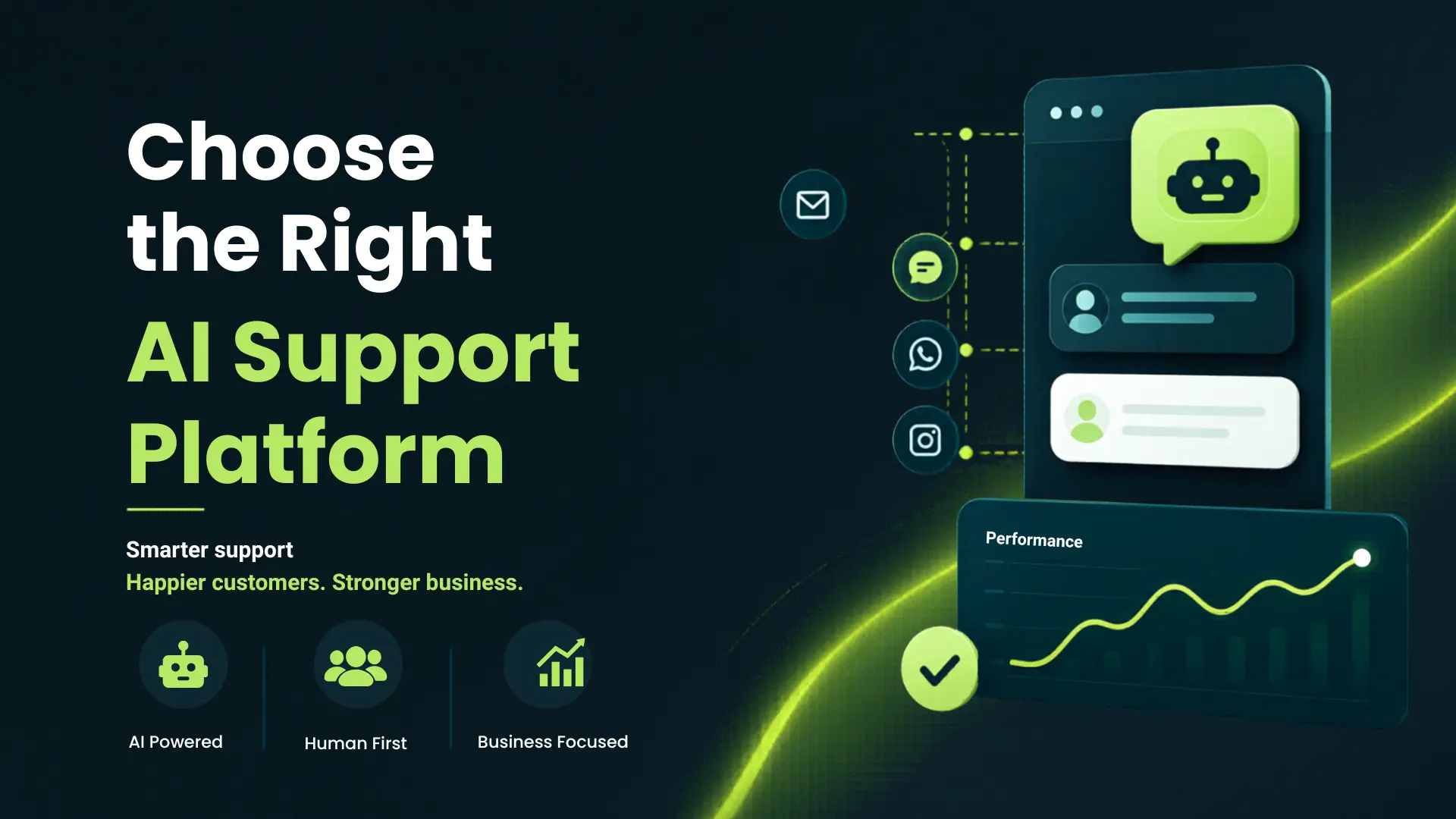
Choosing an AI support platform sounds exciting at first.
You imagine:
- Faster customer replies
- Less repetitive work
- Happier customers
- Smaller support workload
But once you actually start researching platforms, things get confusing quickly.
Every tool claims to:
- “Transform customer experience.”
- “Automate support with AI”
- “Increase efficiency”
Yet many businesses end up choosing software that either:
- Feels too complicated
- Doesn’t fit their workflow
- Costs more than expected
- Creates new operational problems instead of solving old ones
That’s why choosing the right AI support platform isn’t really about finding the “most advanced” tool.
It’s about finding the one that fits:
- Your business size
- Your support style
- Your customer expectations
- Your team capacity
This guide on Servia breaks down how to make the right decision without getting overwhelmed by feature lists or marketing jargon.
First: What Does an AI Support Platform Actually Do?
An AI support platform helps businesses manage customer conversations using automation and artificial intelligence.
Depending on the platform, it can:
- Answer customer questions automatically
- Route conversations to the right team
- Prioritize urgent tickets
- Suggest responses to agents
- Organize support channels in one place
- Provide analytics and customer insights
Some platforms focus heavily on automation.
Others focus more on workflow organization and visibility.
That difference matters more than most people realize.
Step 1: Identify Your Biggest Support Problem
Before comparing tools, ask yourself:
What’s actually slowing down our support right now?
Different businesses struggle with different things.
Common problems include:
- Too many repetitive questions
- Slow response times
- Disorganized inboxes
- Missed customer messages
- Limited support staff
- Poor communication between teams
Your biggest problem should determine your platform choice.
Example
If your issue is:
“We get too many repetitive questions.”
You need strong AI automation.
But if your issue is:
“Our team loses track of conversations.”
You need better conversation management and prioritization.
Those are completely different needs.
Step 2: Understand Your Customer Support Channels
Some businesses mainly use:
Others rely heavily on:
- Live chat
- Instagram DMs
- Facebook Messenger
- In-app messaging
A good AI support platform should match the channels your customers already use.
Why this matters
If your customers constantly move between platforms, disconnected support becomes frustrating.
For example:
- Customer emails you
- Then the messages on Instagram
- Then follow up on live chat
Without omnichannel support, your team sees three separate conversations instead of one complete customer history.
That creates confusion for everyone.
Step 3: Decide How Much Automation You Actually Need
A lot of businesses assume:
“More AI = better”
That’s not always true.
Too much automation can:
- Feel robotic
- Frustrate customers
- Create confusing support experiences
The best support systems usually combine:
- AI automation
- Human support
This hybrid approach works best because AI handles repetitive tasks while humans manage more complex situations.
Good tasks for AI automation
- Password resets
- Order tracking
- FAQ responses
- Appointment confirmations
- Basic onboarding questions
Tasks humans should still handle
- Refund disputes
- Emotional complaints
- Technical troubleshooting
- Sensitive conversations
The goal isn’t replacing humans completely.
It’s reducing unnecessary workload.
Step 4: Choose Based on Business Size
Different platforms work better at different stages of growth.
Small Businesses & Startups
Usually need:
- Simple setup
- Affordable pricing
- Quick automation
- Minimal complexity
Good fit:
Tidio
Freshdesk
Servia
Mid-Sized Businesses
Usually need:
- Workflow automation
- Omnichannel support
- Better reporting
- Team collaboration tools
Good fit:
Intercom
HubSpot Service Hub
Freshdesk
Enterprise Businesses
Usually need:
- Advanced ticket routing
- Large-scale automation
- SLA management
- Deep integrations
Good fit:
Zendesk
Salesforce Service Cloud
Step 5: Pay Attention to Pricing Models
This is where many businesses make expensive mistakes.
AI support platforms often charge based on:
- Number of agents
- AI resolutions
- Ticket volume
- Automation usage
At first, pricing may look affordable.
But as your support volume grows, costs can rise quickly.
Example
A platform charging:
$30/month initially
…may later become:
Hundreds or thousands monthly
…once AI usage scales.
Always check:
- AI usage limits
- Hidden automation fees
- Per-resolution pricing
- Scalability costs
Step 6: Look Beyond Features
A long feature list does not automatically mean a better platform.
Many businesses end up paying for tools they barely use.
Instead, focus on:
- Ease of use
- Workflow simplicity
- Reliability
- Speed
- Customer experience
Sometimes the simpler platform creates the best long-term results.
Step 7: Test the Human Experience
This step gets ignored constantly.
Before choosing any platform:
- Test the chatbot yourself
- Check response quality
- Try escalation flows
- Use the support interface like a customer would
Ask yourself:
“Would I personally enjoy getting support through this?”
That answer matters.
Related: Top Customer Support Ticketing Systems for SaaS Companies (2026)
Popular AI Support Platforms in 2026
Common Mistakes Businesses Make
Choosing based only on popularity
The biggest platform isn’t automatically the best fit.
Over-automating too early
Customers still want human support when issues become complicated.
Ignoring onboarding difficulty
Some platforms require weeks of setup and training.
Focusing only on short-term pricing
Cheap upfront pricing can become expensive later.
Related: AI vs Traditional Helpdesk Software: Which Is Better in 2026?
Final Takeaway
The right AI support platform depends less on “which tool is best” and more on:
- How your team works
- How your customers communicate
- How much complexity do you actually need
For some businesses, advanced enterprise workflows make sense.
For others, simplicity and automation matter more.
The best platform is the one that:
- Reduces workload
- Improves customer experience
- Scales with your business
- Feels manageable for your team
Because good customer support isn’t just about faster replies.
It’s about creating a smoother, less stressful experience – for both customers and your team.
Best AI Support Platform FAQs
Everything you need to know before choosing the right AI support platform for your business.
What is an AI support platform?
An AI support platform helps businesses manage customer conversations using automation, chatbots, ticketing systems, and AI-powered workflows.
How do I choose the best AI support platform?
Start by identifying your biggest support challenge, your communication channels, your budget, and the level of automation your business actually needs.
Are AI support platforms suitable for small businesses?
Yes. Many platforms, such as Tidio, Freshdesk, and Servia, are designed specifically for startups and smaller teams.
Can AI completely replace customer support teams?
No. AI is best used for repetitive and routine tasks, while human agents still handle complex or sensitive customer interactions.
What features matter most in an AI support platform?
The most important features are:
- Omnichannel support
- Automation quality
- Ease of use
- Fast human escalation
- Workflow organization
- Reliable reporting